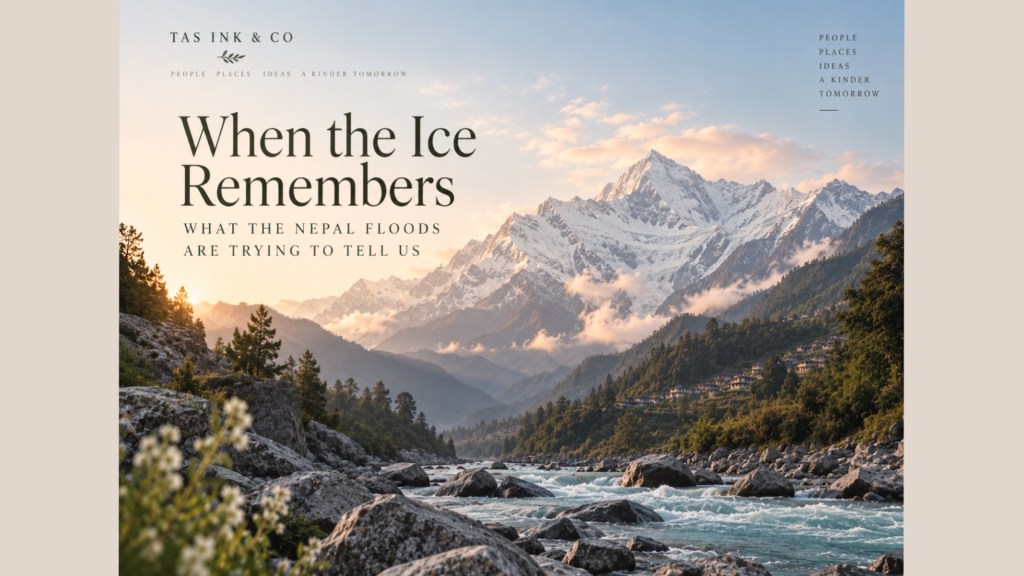
Sometimes mornings define a difference between before and after. For the village communities around the Trishuli River in Nepal, that day became August 26, 2026.
The morning started calmly, as many catastrophic events begin, until it is too late. High in Langtang National Park, on the slopes of Langtang Lirung, a part of the glacier that had held for decades suddenly collapsed. The process that started was not gradual melting but rapid decomposition—a debris flow and flash flood that swept 60 miles along the Trishuli River, taking away homes, bridges, roads, and even a border crossing point between Nepal and China within a few hours.
After everything settled, there were more than 1,300 victims whose deaths could be confirmed. Over 5,000 people were unaccounted for. The flood took bodies of people as far as India, which is several hundred kilometres from the place of the catastrophe. Whole generations of communities have vanished within a few hours.
This Wasn’t a Freak Accident
One is tempted to categorise it as yet another tragic coincidence where geology and climate come together. But it is not the case.
The very same valley was flooded before. Back in 2015, the Langtang Lirung saw the collapse of a glacier that killed hundreds of people and buried villages under its debris. And just one year ago, in July 2025, a glacial lake outburst flood struck the same border region and took away a bridge. Now, in 2026, the mountain broke once again, but this time in an even more devastating way.
Three events. The same valley. Eleven years. It cannot be mere bad luck.
The Science Behind the Silence
Glaciers are not just ice blocks; they are dynamic equilibrium systems that contain huge volumes of frozen and melted water in lakes trapped within ice sheets. As temperatures rise, this balance is disrupted as the rate of melting exceeds snowfall. Meltwater accumulates on glaciers in the form of lakes held back by unstable natural dams of rocks and debris. Mountains and slopes frozen solid by permafrost become unstable.
Ultimately, something has to give. Either there is a rupture of an overloaded lake, which is called a Glacial Lake Outburst Flood (GLOF), or, as was the case in Nepal, the glacier itself is released to cause a debris avalanche. Scientists investigating the collapse of the glacier in August 2026 found evidence that climate change destabilised it.
Here lies a subtlety headlines often miss: a warming Earth means not only warmer climates and melting polar ice caps, but also mountains that become less stable. Valleys that have been safe for many years are suddenly no longer so.
The Distance Between Cause and Consequence
Some aspects make such a climate disaster tough to swallow: the people bearing the brunt of it are almost certainly not the ones who made the decisions that led to it.
The emissions heating the Himalayan region certainly don’t come from any village near the Trishuli River. They come from industries, transport systems, and electricity grids located thousands of miles away – from individuals whose lives are characterised by consequences arriving via newspaper headlines and not floods. The Langtang valley never did anything wrong that would lead to such a tragedy. It just happened to be located downstream, in more ways than one, from actions taking place in another part of the world.
This is the harsh reality which lies at the heart of the climate crisis: it’s a tale of distance.
Nature Isn’t Punishing Us. It’s Responding to Us.
It’s tempting to fall back on rhetoric such as “nature’s revenge” or “the earth striking back.” But this kind of language absolves us of some responsibility, as if nature were an external agency attacking us rather than an interconnected system we are very much part of.
The disaster in Nepal is not nature retaliating against us. It is simply a physical process responding, just as physics dictates, to the heat buildup over many decades within the atmosphere. The glaciers do not harbour grievances; they store ice, and when the conditions that have been preserving that ice change, the ice itself changes.
This new perspective matters because it shapes how we act from here. If nature is striking back at us, all we can do is take the punishment. But if nature is responding to us, then we play a role in determining the outcome.
What We Carry Forward
But, of course, it’s far too simple to end a post like this with a rallying cry: reduce emissions, preserve glaciers, fix the planet. They are all right, of course. There is a quieter reality to contemplate, however, which is the realisation that we are inseparable from the systems in which we participate.
The glacier of Langtang Lirung existed for thousands of years before it no longer did. It did not melt overnight, nor will it be reversed overnight. But, in theory, any system that changes in one direction can change back — as long as enough decisions, made by enough people, move in the same direction.
The people of the Trishuli valley had no voice in the decisions that altered their mountain environment. We, at least, owe them that much.
 Tas Ink & Co
Leave a comment