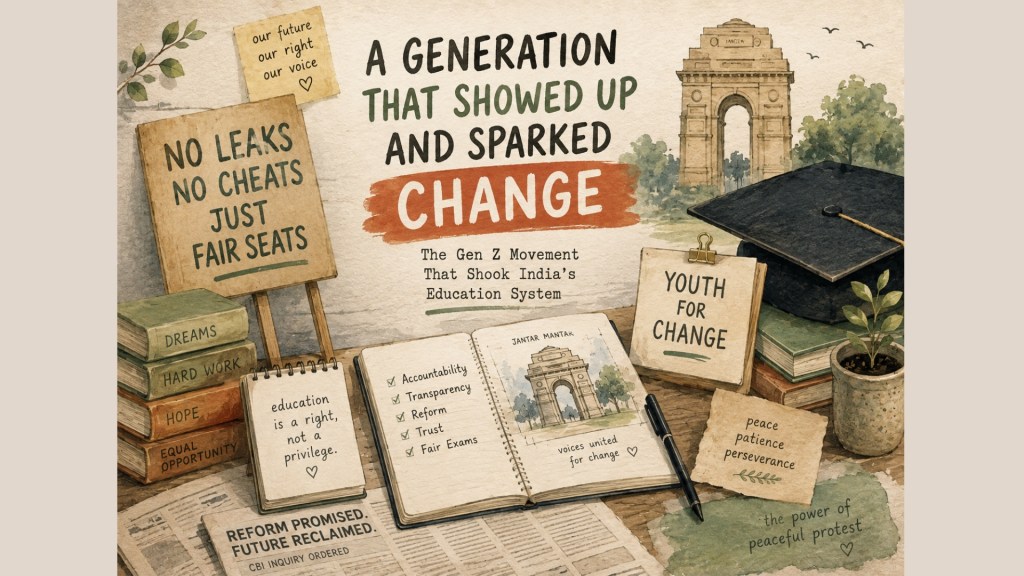
For some time now, the narrative of Indian youth has been one of being too absorbed in reels and ranks to think beyond their own timelines. However, in 2026, everything changed in the most public manner possible at Jantar Mantar, in the very heart of New Delhi, on an issue familiar to all Indian households: the sanctity of the exam.
This is the story of how a Gen Z protest movement, driven by Sonam Wangchuk’s hunger strike, transformed the discourse around the Indian education system, leading to the resignation of a Union Education Minister.
The NEET Paper Leak That Sparked the Movement
The initial signs of malpractice in NEET UG, the pivotal exam that shapes the future of every aspiring medical professional in the nation, surfaced in May 2026. NEET is not only an examination for many aspirants, but also years of tuition classes, family sacrifices, and a single opportunity for a future career. When news of the exam paper leak reached everyone, it was more than just another case of poor organisation. It was a feeling of being betrayed by the one institution that students were expected to trust—that if you worked hard enough, the system would treat you fairly.
What started as a one-time protest became the beginning of something much larger, a nationwide student movement against exam cheating led by a youth group called the Cockroach Janta Party (CJP).
Sonam Wangchuk’s Hunger Strike: The Turning Point
Sonam Wangchuk, an engineer known for his long-standing efforts to reform education in Ladakh, joined the protests and went on a hunger strike in solidarity with the students.
Wangchuk fasted for 26 days. When he was forcefully pulled out of the protests and rushed to a hospital in mid-July, everything changed. From a passionate, yet restrained, student protest, it suddenly became a Gen Z movement across the country. Thousands of people, most of whom had never participated in any protest before, joined in. Support came from actors, alums, and even strangers who could not bear to watch a 59 year old man sacrifice himself for their future.
This is worth considering: Wangchuk himself objected to being hailed as a hero. He repeatedly insisted that he was no Gandhi, but only wanted people to give up on saviours and become heroes in their own lives. This single message might well be the most Gen Z idea ever conveyed by an almost a 60 year old, stop waiting for someone else to do something about it.
The Resignation That Proved the Protest Worked
On July 25, 2026, Dharmendra Pradhan, who was then the education minister in the Union Cabinet, stepped down. According to him, this step was taken in the interests of students rather than out of self-interest. Consequently, the government decided to launch a CBI inquiry into the case, to cancel the flawed examination, and to pledge to conduct future examinations in a computer based mode. The Cockroach Janta Party suspended its agitation “in good faith,” while Wangchuk, ending his hunger strike, described this act as “a victory of peace, patience and perseverance.”
For a generation often accused of disinterest, this act proved the opposite. A minister resigned; a policy was changed; and all this resulted from students’ insistence.
Why This Gen Z Movement Matters for India’s Education System
But to see it this way would be missing the point of a much larger narrative: An entire generation has learned that collective and sustained peaceful pressure can work in a democracy. There is no individual influencer behind this; there is no individual party behind it. The movement was decentralised, spearheaded by a group of students who knew something that some of their elders may have forgotten, that showing up is power.
Is one resignation going to solve India’s exam problem? Of course not; it’s a long, hard battle, and it’s entirely reasonable to keep a close eye out to ensure that promised reforms like moving towards computer-based tests are implemented as intended.
But few movements start with all the answers. Movements start when people decide they cannot remain silent any longer, and this is precisely what Gen Z did in the summer of 2026. They showed India that a generation of digital natives can still stand in solidarity in the real world over something that really matters.
 Tas Ink & Co
Leave a comment