There was a time when news of a murder would shock an entire nation. Nowadays, though, it’s common to see terrible headlines on our screens. A husband kills his wife. A child endures unimaginable torture. A friend betrays a friend. A relative becomes the last person you’d want nearby.
And perhaps the most disturbing part is not just the violence itself—it’s how quickly we have begun to expect it.
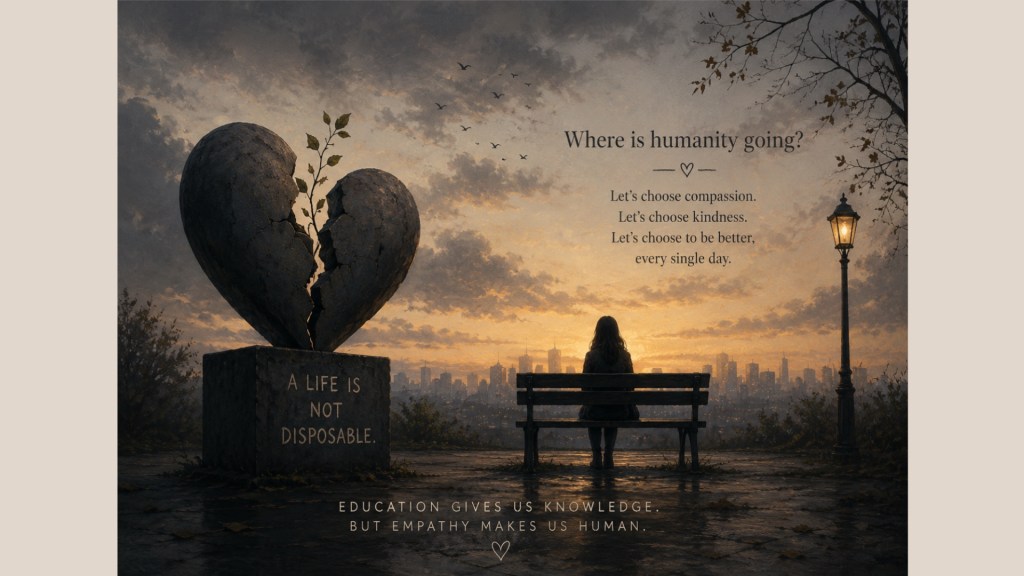
I often find myself asking: Where is humanity going?
But many of the accused are not uneducated; they know right from wrong. They are doctors, engineers, entrepreneurs, professionals, graduates—individuals we would consider successful. Through education, we have gained knowledge, skills, and careers. But education alone cannot teach empathy, patience, or compassion.
Somewhere along the way, success began to matter more than character.
We are living in an era where everything is instant. We seek instant riches, fame, solutions, and some individuals look for quick escapes from their own problems.
No frustration, betrayal, failed relationship, or personal crisis can ever justify choosing violence. There are always other choices.
A life is not disposable.
This tragedy is worsened by social media. We watch criminal stories on television. We turn to the next story and slowly stop feeling. But in every story, a family has been forever shattered.
The victims are not statistics.
However, the accused aren’t just “monsters” who have always been that way. They might once have been ordinary people who let emotions like rage, greed, envy, egotism, vengefulness, or obsession get out of control and cross the point of no return. It does not mean their actions were right—it merely shows how our character develops from the choices we make.
Perhaps that is the real crisis.
While our education system has seen significant investment, it often neglects emotional intelligence. Success is celebrated, yet conflict resolution remains unspoken. We encourage ambition but sometimes overlook empathy. Our guidance focuses on achieving success, but we seldom address how to handle failure, rejection, disappointment, or loss.
What if empathy was taught in schools with the same rigour as mathematics? What if workplaces valued mental health as highly as productivity? What if families openly discussed their feelings instead of holding onto negative emotions?
Would we still be reading the same headlines?
Undoubtedly, violence has existed since the dawn of human civilisation. Humanity has never been perfect. However, history has shown that each generation has the potential to improve upon the one before it. We have abolished barbaric institutions and established human rights and just societies. Change can happen—but it will never be easy.
It begins with each of us making better choices.
Choosing dialogue over rage.
Choosing honesty over manipulation.
Choosing forgiveness over revenge.
Choosing compassion over selfishness.
So, will humans ever improve?
I want to believe we can.
Not because I see any reason for optimism from the media, but because history reminds us that lasting change begins with individuals who refuse to let hatred define them. Humanity’s salvation does not come through eloquent speeches. Instead, it manifests in simple acts of choosing patience over aggression, understanding over condemnation, and love over hate.
Every alarming headline should make us pause and reflect not only on what has happened but also on the society we have built.
Because if we lose our humanity, no amount of education, technology, or wealth will ever make us truly civilised.
Perhaps the real measure of progress isn’t how intelligent we’ve become.
It’s whether we’ve remembered how to be human.
 Tas Ink & Co
Leave a comment